
On Saturday, September 17, 1977, I returned to Japan after a three-week business trip to Europe. One month later, on Wednesday, October 19, I visited Mr. S, General Manager of Sales, at the head office and reported on the trip. Afterward, he took me to meet Executive Director K. It appeared that Mr. K had heard from Mr. S about my work on the Ena-san Tunnel and the completion of my doctoral degree. Mr. K was also my senior from the Department of Electrical Engineering at Kyoto University, having graduated in 1938.
I believe that Mr. S arranged the meeting with Executive Director K to obtain his informal approval for my transfer from the research laboratory to the manufacturing works.
Soon afterward, Mr. B, General Manager of the Systems Department at the Central Research Laboratory and my supervisor, called me into a conference room. He said that Mr. C, General Manager of the Public Systems Department at the Control Equipment Works in Kobe, had come to see me. Mr. C directly asked me, “Would you like to leave the Central Research Laboratory, join the Control Equipment Works, and take part in systems development in the Public Systems Department?”
For me, the timing was ideal. My work at the Central Research Laboratory had reached a natural stopping point, and I had completed my doctoral degree. I was grateful for the offer and immediately replied, “Yes, I would be very pleased to accept.”
I do not know whether Mr. C personally decided to invite me from the Central Research Laboratory or whether he acted on the advice of Executive Director K and Mr. S. However, the latter seems more likely. Executive Director K and Mr. S may also have discussed the matter in advance with Mr. B at the Central Research Laboratory.
On April 1, 1978, I transferred from the Systems Department of the Central Research Laboratory to the Public Systems Department of the Control Equipment Works.
My new workplace was located within the Kobe Works in Wada-misaki-cho, Hyogo Ward, Kobe. The house I had bought while working at the Central Research Laboratory was in Akura, Takarazuka. My journey involved taking a bus to Hankyu Itami Station, trains from Itami to Tsukaguchi and from Tsukaguchi to Sannomiya, and then another bus to Wada-misaki. The commute took nearly one and a half hours and was inconvenient.
Because I expected to work in Kobe for a long time, I began considering moving my home to Kobe.
Committee on the Operation of the Longitudinal Ventilation System for the Kan-Etsu Tunnel (Part 1)
The main work of the Public Systems Department at the Control Equipment Works involved electrical equipment for water-treatment processes. The road-tunnel electrical-equipment business was smaller than the water-treatment business. I was assigned to water-treatment work and joined a team studying the operation of the water-treatment process at the Morigasaki Water Reclamation Center of the Tokyo Metropolitan Government Bureau of Sewerage. This was a major project lasting several years, but I will not discuss it in detail here. I still clearly remember spending several years with the team at the Sawanoi Inn in Omori, Tokyo, where we lived and worked together for extended periods.
On June 23, 1978, Mr. Ueki, a section manager at the Japan Highway Public Corporation, asked me to come to its head office from the Sawanoi Inn in Omori. From there, Mr. Ueki and I visited Professor Ohashi of the Department of Mechanical Engineering at the University of Tokyo in Hongo, and Mr. Ueki introduced me to him. Professor Ohashi was a distinguished scholar who had served as President of the Japan Society of Mechanical Engineers. He was also deeply interested in road tunnels and was one of the leading figures in the field. Until then, major Japanese road tunnels, including the Kanmon, Tennozan, and Ena-san tunnels, had used transverse ventilation systems, which were standard in Europe. Professor Ohashi held the innovative view that Japan, which would need many more tunnels, should promote the simpler longitudinal ventilation system.
In the introduction to the collected research report on the operation of the Kan-Etsu Tunnel ventilation system, Professor Ohashi briefly described the background to the selection of the ventilation method as follows:
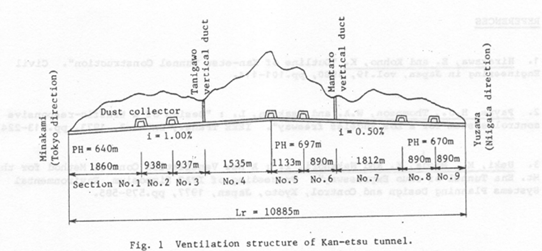
“The ventilation system for this tunnel was planned on the basis of research conducted from 1966 to 1976 on dust-collection technology for tunnel air, research in 1976 on a longitudinal ventilation system using supply and exhaust shafts, and the work of the Special Committee on Long Road Tunnels in 1977. It was a unique system using supply and exhaust shafts together with electrostatic precipitators. Compared with the transverse and semi-transverse systems used in earlier long tunnels, it was expected to reduce construction costs and save ventilation power.”
I explained how I had developed ventilation control for the transverse ventilation system of the Ena-san Tunnel and how simulation had been used in the study. Professor Ohashi listened quietly and then commented, “So, someone has finally begun using road-tunnel simulation in Japan.” I still remember his words very clearly.
On September 27, 1978, tunnel-ventilation engineers from Company H, Company T, and Mitsubishi Electric gathered at the head office of the Japan Highway Public Corporation. Mr. S from Company H, Mr. K from Company T, and I, representing Mitsubishi Electric, explained our companies’ activities. This was followed by several individual interviews and joint meetings among the three companies.
At 1:00 p.m. on Tuesday, December 12, 1978, the committee formally began its work at the Express Highway Research Foundation. Twelve first-year members, including Chairman Ohashi, attended. I joined the committee as a manufacturer’s representative together with Mr. S from Company H and Mr. S from Company T. At the meeting, Chairman Ohashi announced a policy of using simulation to study ventilation operation, and I was assigned responsibility for the simulation work. Committee member D also asked each manufacturer to propose a ventilation control method.
The ventilation system diagram for the Kan-Etsu Tunnel is shown below. [1]
When I reported the committee’s activities to the relevant people within the company, Mitsubishi Electric decided to take an active approach to the project. I therefore asked the Central Research Laboratory for support, and Mr. N was assigned to work on the project full-time. For the simulation, we decided to develop a longitudinal ventilation simulator for the Kan-Etsu Tunnel, using the transverse ventilation simulator developed for the Ena-san Tunnel as a reference. Mr. N wrote the program. For the Kan-Etsu Tunnel ventilation control method, we also adapted the traffic-prediction regulator control developed for the transverse ventilation system of the Ena-san Tunnel to a longitudinal ventilation system and proposed it to the committee. No other companies submitted alternative ventilation control proposals, so we proceeded to verify the effectiveness of our method through simulation.
The third committee meeting was held at the Express Highway Research Foundation on February 23, 1979. Eighteen members attended, including Professor Ohashi, university researchers, representatives of the Fire Research Institute, the Metropolitan Expressway organization, consulting firms, manufacturers, and the Japan Highway Public Corporation, which organized the committee. Mr. N and I attended from Mitsubishi Electric. Using the requested configuration diagram of the ventilation control simulation and our study report, we presented the results of the first year’s work. The configuration diagram submitted at that time was the same one later published in the proceedings of the Fourth International Symposium on the Aerodynamics and Ventilation of Vehicle Tunnels, held in York, United Kingdom, on March 23-25, 1982. [1]
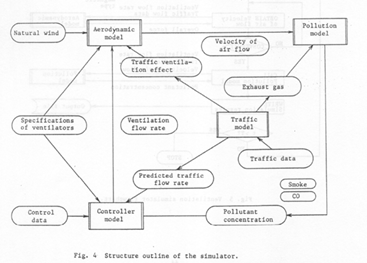
The simulator consisted of four main elements: a traffic model, a pollution model, a control model, and an aerodynamic model. Using this simulator, we presented the tunnel air velocity and pollution concentration distributions obtained when applying the optimal regulator ventilation control method based on traffic prediction, which had been developed for the longitudinal ventilation system of the Kan-Etsu Tunnel.
The committee consisted of specialists from many different technical fields. In addition to experts in tunnel civil engineering and tunnel safety, it included specialists from manufacturers in ventilation equipment, power receiving and distribution systems, and dust-collection equipment, as well as road-company experts with extensive knowledge of field operations. I was concerned that it might be difficult to explain ventilation control to such a diverse group. Fortunately, this concern proved unnecessary. The committee members correctly understood the computer simulation results presented in graphs. At that moment, I strongly realized that simulation could serve as a common language across different technical fields. The control method proposed here was studied further and was eventually adopted for the normal operation of the Kan-Etsu Tunnel.
[1] H.Ohashi, A.Mizuno, I.Nakahori, M.Ueki “A New Ventilation method for the Kan-Etsu Road Tunnel” P31-47. Aerodynamics & Ventilation of Vehicle Tunnel (March 1992)